Quincy Smelting Works

4
Nov

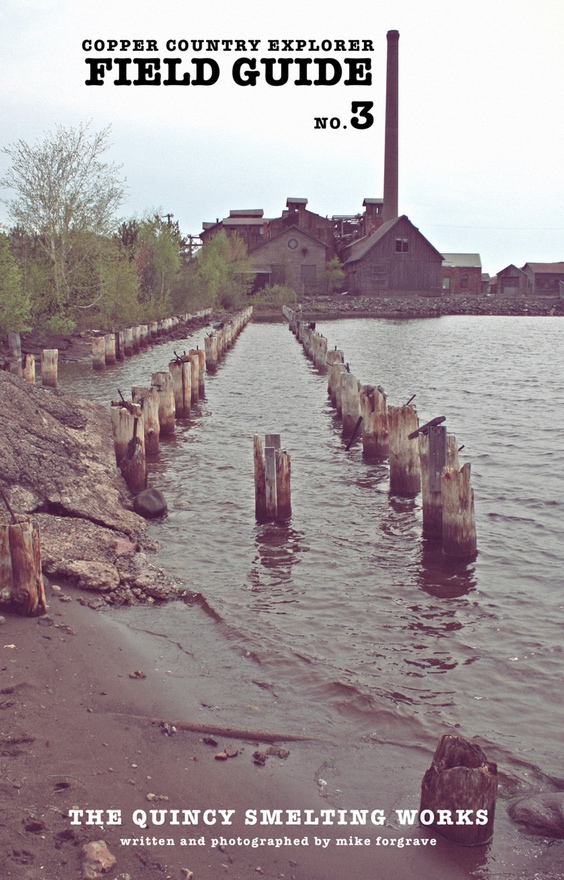
The Quincy Smelting Works is the last of the last, a lone remnant of an industrial juggernaut that once lined the Portage Waterway for miles. Like her shoreline brethren, the Quincy complex existed only to serve its copper masters, and when the copper empire died she died along with it. As time marched forward the sprawling industrial ruins around her were sacrificed to the region’s new master – tourism. The shoreline on which smelters, foundries, warehouses, and coal docks once stood were transformed to parks, boardwalks, and rows of townhouses. But through it all the Smelter has remained. Though battered and bruised and showing her age, the old gal continues to remind us all of the copper country’s rich industrial heritage.

VIEW POST »
5
Nov

The Quincy Smelter’s Mineral House (marked with an arrow) was built in 1904 to replace the old railroad warehouse sitting in front of it.

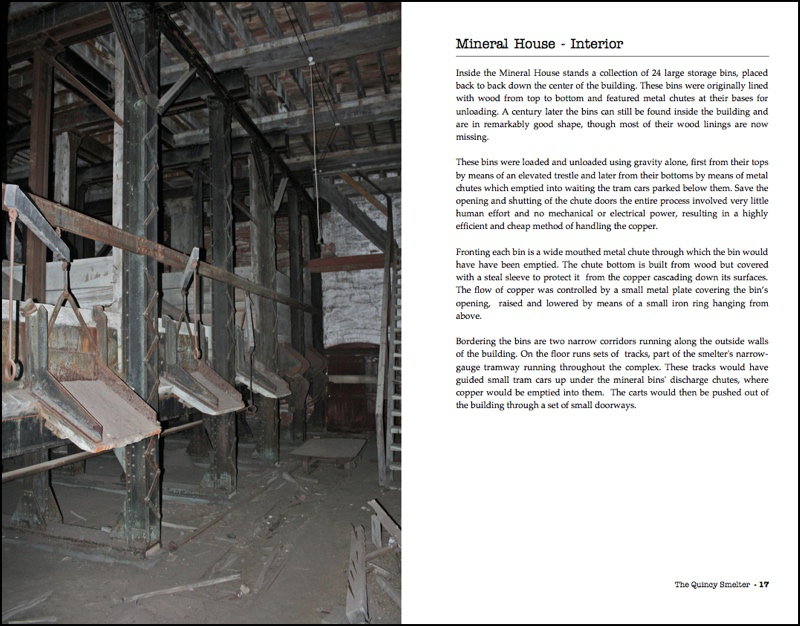
While the Quincy Smelting Works were constructed in 1898, the complex wouldn’t acquire a dedicated mineral house for six more years. In those early years copper ore arrived to the complex packed in barrels, which were then offloaded from train cars in a large wood-framed warehouse on the plant’s northern end (seen immediately in front of the current mineral house in the photo above). From there the barrels would then be loaded onto hand trucks and brought down to the furnace building for smelting. Before long it became apparent to Quincy management that this labor-intensive process was highly inefficient, and a drain to the company’s bottom line. To remedy this situation a more automated system would be installed in 1904, replacing the barrels with automatic discharge bins and the hand trucks with tram cars. At the center of the entire system was the Mineral House.

VIEW POST »
6
Nov

The Quincy Smelter’s mineral house was a vital component of the company’s move to minimize its labor overhead and streamline its ore handling process. This was primarily accomplished through the use of 24 mineral storage bins, place in two back-to-back rows through the center of the building. These bins were loaded and unloaded using gravity alone, first from the top by means of an elevated trestle and later at the bottom by a series of chutes which emptied into waiting tram cars. Save the opening and shutting of both the bin and ore car doors, the entire process involved very little human effort and absolutely no energy requirements.

VIEW POST »
9
Nov

The minerals arriving to the Quincy Smelter were historically of two basic types – small to medium sized pieces referred to as barrel copper and larger more substantial pieces known as mass copper. Both of these types were easily smelted in the complex’s furnaces without much difficulty. But as stamping technology improved – as it did at the Quincy Mills around the turn of the century – the size of the copper being captured at the mills were becoming smaller and smaller. Soon the smelter was receiving copper in sizes bordering that of dust, flakes of metal too small to process adequately in the smelter’s furnaces – copper that would simply be sucked up the flue before it had a chance to melt.

VIEW POST »
10
Nov

A typical briquetting plant is essentially a mixing and pressing operation, utilizing generally two primary ingredients: the material to be made into briquettes and the binding agent necessary for that to happen. Those two agents are then mixed thoroughly and mechanically pressed into a small cylinder which is then cut up into several discs. Those discs are the briquettes, and are then transported to the furnace for smelting.

VIEW POST »
11
Nov

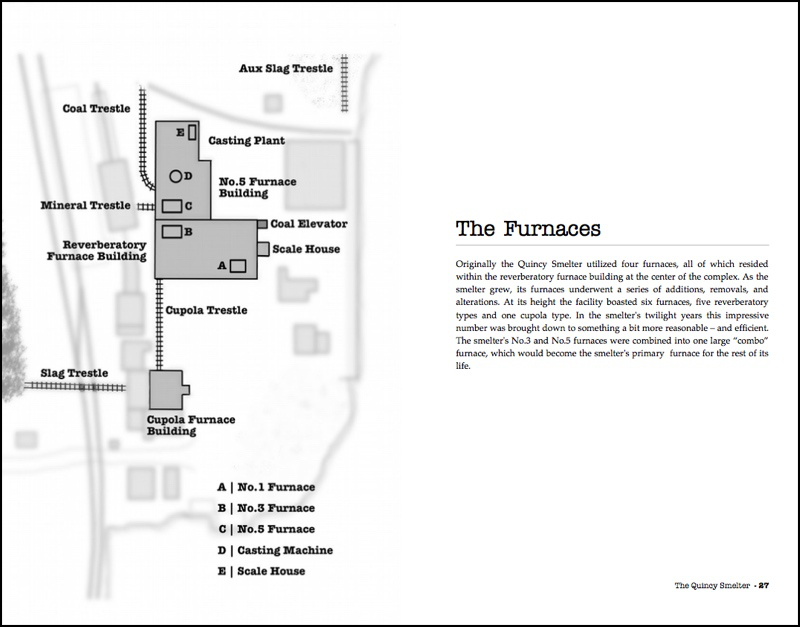
At the heart of any smelting operation is the furnace, where the actual work of melting and refining takes place. At the Quincy Smelting Works that furnace was of the reverberatory design, utilizing natural draft and a reflective (reverberating) thermal dynamic to convert the copper ore into molten metal. The Quincy complex utilized four of these furnaces, housed in a large sandstone building known as the Reverberatory Furnace Building.

VIEW POST »
12
Nov

When it was first built in 1898 Quincy’s furnace building was home to a total of four reverberatory furnaces. The furnaces had a combined monthly capacity of 1600 tons with each furnace having the capacity of smelting 36,000 pounds of mineral in a 24 hour period to produce an average of 26,000 pounds of copper ingot. If operating at full capacity the smelter could theoretically produce some 2.5 million pounds of copper in a month’s time. That’s a staggering number considering the output of the mine itself averaged only three-quarters of a million pounds for the same period – an excess capacity of over a million and a half pounds. But Quincy was a company that liked to think – and act – bigger then life. The smelter was no exception.

VIEW POST »
13
Nov

The copper rock which reached the smelter was anywhere from 70 to 90 percent pure. Due to the unique nature of Lake Superior copper, most of the impurities in that copper were simply pieces of foreign rock imbedded within the copper itself. As a result Copper Country smelters – including the Quincy Smelting Works – utilized a rather uncomplicated procedure to purify its copper wares. A process that essentially boiled down to melting the copper and skimming off its impurities. At the heart of that process was the reverberatory furnace.

VIEW POST »
16
Nov

When the Quincy Smelter was first built, its compliment of four reverberatory furnaces was more than adequate in meeting the company’s needs. Over the ensuing years the smelter’s capacities would become strained as the complex began handling an increased workload from not only the Quincy Mine itself, but also a dozen or so independent mines that were also using the smelter for its own copper. In response the company erected a new furnace and a new building to house it just to the east of the original furnace building. This new furnace was known as the No.5.

VIEW POST »
17
Nov

Unlike its predecessor to the west, the No.5 furnace building is a very plain and uninspired. As a simple iron truss structure covered in steel sheeting it pales in comparison to the older building next door. Inside the building is just as pedestrian, an observation we made almost immediately as we entered. It was as if we had crossed through a century of time and entered a steel and iron monstrosity of a more modern age. But this was what the constraints of diminishing resources and an uncertain future spawned in the Copper Country. Gone was the pompous exuberance of the region’s boom-time attitude and in its place had grown the stark reality of an industry in decline.

VIEW POST »